
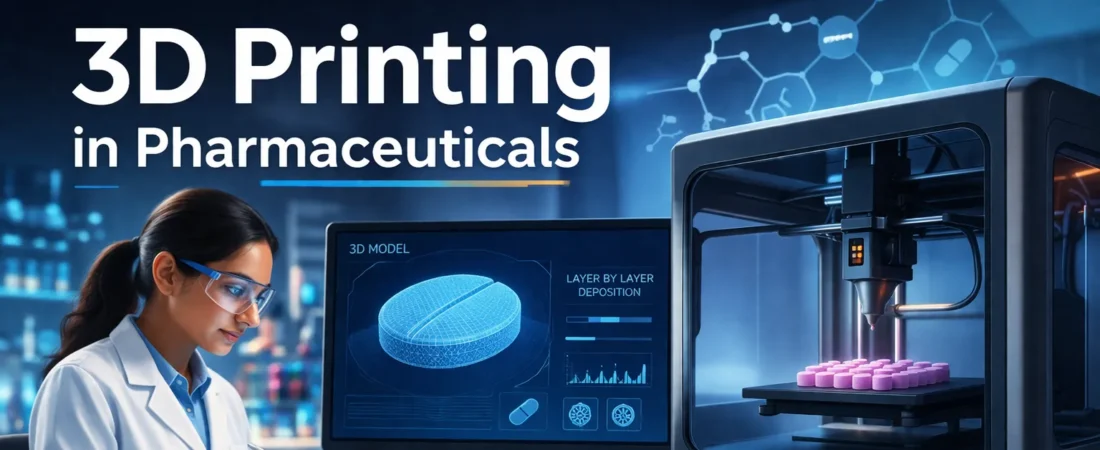
3D printing in pharmaceuticals for B.Pharm: personalized tablets, polypills & project ideas for 2026. Latest trends and career scope.
3D Printing in Pharmaceuticals
3D printing technology is rapidly transforming pharmaceutical manufacturing. In 2026, many B.Pharm students are choosing 3D printing topics for their final year projects due to growing industry interest and government support under advanced manufacturing initiatives.
This guide provides practical project ideas, benefits, and tips to make your B.Pharm project stand out.
Why 3D Printing is Trending for B.Pharm Students in 2026
- Enables true personalized medicine with patient-specific dose and shape
- Supports development of polypills (multiple drugs in one tablet)
- Reduces manufacturing waste compared to traditional methods
- Strong connection with Novel Drug Delivery Systems and Industrial Pharmacy
- High chances of publication and good placement opportunities
Best 3D Printing Project Ideas for B.Pharm Final Year
-
Development of 3D Printed Immediate Release Tablets
- Drugs: Paracetamol, Metformin or Atorvastatin
- Focus: print quality, disintegration time and comparison with market tablets
-
3D Printed Polypill for Cardiovascular Patients
- Drugs: Aspirin + Atorvastatin + Ramipril
- Goal: layered release for better patient compliance
-
Orodispersible Films (ODFs) by 3D Printing
- Drugs: Ondansetron or Montelukast
- Target: pediatric and geriatric patients
-
Floating Gastroretentive Tablets using FDM 3D Printing
- Drug: Metformin or Famotidine
- Evaluation: buoyancy time and sustained release
-
3D Printed Chewable Tablets for Children
- Drug: Albendazole or Azithromycin
- Focus: taste masking and mechanical strength
Important Tests to Include in Your Project
- Weight variation and dimensional accuracy
- Hardness, friability and disintegration time
- In-vitro drug release study
- Surface morphology using microscopy
- Stability study under accelerated conditions
- Comparison with conventional marketed products
Common Challenges & Easy Solutions
- Nozzle clogging → Optimize temperature and polymer selection
- Poor layer bonding → Use suitable polymers like PVA or HPMC
- Limited access to printer → Collaborate with college lab or nearby research centre
- Regulatory questions → Focus on “point-of-care” or compounding applications
Future Scope of 3D Printing in Pharmaceuticals
- Hospital-based 3D printing for personalized doses
- More B.Pharm colleges adopting desktop 3D printers
- Integration with AI for formulation optimization
- Growth in pediatric and geriatric dosage forms
Action Plan to Start Your Project
- Choose a BCS Class II or IV drug with solubility issues
- Select FDM or Semi-solid extrusion printing method
- Finalize polymers (PVA, HPMC, Soluplus)
- Use Design of Experiments (DoE) for better results
- Compare your printed tablets with marketed products
3D printing projects are currently among the most innovative and industry-relevant topics for B.Pharm students in 2026.